Showing posts with label stem cell transplant. Show all posts

Monday, October 3, 2011

9 1/2 month post-transplant update

Chris at the top of the Duomo in Florence. Did we mention
that it was 462 steps to the top?
We celebrated Chris' 9 month transplant anniversary in style. To celebrate our first year wedding anniversary (September 18), we headed to Italy and are pleased to report the incredible changes we noticed in Chris' condition.

Prior to his transplant, Chris had a really hard time walking long distances, whether he was having a relapse or not. It was almost impossible for him in hot weather.

Italy definitely posed a challenge. Anyone who has been to Italy knows that to see all of the sites requires a lot of walking and a lot of stairs. And of course, there was a heat wave in Italy when we went and it was 34 degrees everyday.

But throughout our entire trip Chris had no problem walking, climbing and sometimes breaking into a jog (when he accidentally left our camera at the restaurant!).

The first thing we noticed was the lack of Chris' "floppy foot." (In case you hadn't figured, that is not a real medical term). It is caused by muscle weakness and tightening in Chris' left leg and the term "floppy foot" comes from the loud sound his foot makes when it flops on the ground. The sound is usually my first indication that Chris is having walking difficulty (because Chris never wants to admit it) and unfortunately it causes him to have really bad knee and hip pain.

Over the years we have both become accustomed to this noise when walking and it wasn't until a few days into the trip that we realized that we never heard it, not even once.  We even had days where we walked upwards of 20 km and climbed 800 stairs in 30 degree weather and Chris never once had to rest or felt any discomfort.

Even if you compare this to a few months ago when we were in Montreal (see last blog post), this is a huge difference. In Montreal, Chris found that the heat made it harder for him to walk and he did need to take a break because his "floppy foot" had kicked in and it was causing pain in his hip.

So throughout the trip we kept on trying to do things that Chris would have never been able to do before his transplant. It was a great vacation.

After coming back from Italy, we decided to head to the gym to burn off all of the pasta we ate and Chris decided to go on a treadmill for the first time in 5 years.

He isn't close to running marathons (yet!), but he was able to run for 15-30 second intervals at a pretty high pace. A year ago at this time, Chris couldn't even force his body to run.

We have also received Chris schedule for his research study. On December 4, Chris will have his 1 year MRI and then we will get to review it, along with Chris' previous MRIs, with Chris' neurologist on December 12.

We are really excited to see the difference in his MRI. With all of the changes that we are seeing, we know that there has to be a visible change in the lesions on Chris' brain. We are just curious to see how different his MRI will be from last year.

For us, the question is not "Did this procedure work?" its "How well did this procedure work?" I am hoping the Chris wins most improved.

Tuesday, March 29, 2011

Day +106

A lot has changed over the last month, especially in terms of Chris' health.

Since I am his wife I might be biased, but I think
Chris is looking pretty good! Look at that hair!

After having such a positive appointment last month, Chris went back to work on March 7 (less than three months after his transplant). Since his doctor recommended that he take a graduated approach, Chris worked three days that week, four the following week and then worked a full week last week. Really, looking back, we figure that Chris could have just gone back full-time. He has never really felt that tired (no more than usual after a work day) and has been able to jump right back into things.

A lot of his clients (Chris works in engineering) didn't know that he had been on a leave of absence. Since the majority of Chris' construction projects take place in the spring and summer, it is not uncommon for Chris not to meet with anyone during the winter. On his first week back he met with one of his main clients and they commented on his lack of hair by asking if Chris had lost a bet. I am assuming this because they had no idea what Chris had been through and thought his buzz cut had been a personal choice. The protective wife in me, however, would like to give them a hard time for being so insensitive. I think he looks pretty cute.

Chris is still working out, but has slowed it down a bit since his knee started to hurt him. He was up to doing 80 minutes on the elliptical, but is only doing weights until his knee is back to normal. The knee that hurts is, of course, his left knee (the leg that was affected by his MS).

On Sunday, Chris went in for his monthly IVIG treatment and since his regular BMT appointment was today, they ended up doing some blood work, so that we would have his results for his appointment.

Despite feeling better, Chris' bloodwork through us for a loop. We had already been told that they were going to discharge Chris from the BMT program and send him to the MS clinic. However, when they went to check his bloodwork the whole computer screen was full of red numbers. All of Chris' counts were MUCH lower:

White blood cells: 2.1 (normal 4.3 -10.8)
Platelets: 77 (normal 150-450)
And then remember that we stopped listing his neutrophils because they were so high that it didn't matter, well they had crashed down to 0.8 (1.8 -7). Chris wasn't allowed to leave the hospital until they were 0.5.
So needless to say we were a little concerned at first.

They retested Chris' blood again today and his white blood cells and platelets were higher than Sunday (3.5 and 85) and we are still waiting to get his neutrophil count, which will have likely risen too.

His doctors weren't 100 per cent sure why his counts were low. The one explanation is Chris had a mild allergic reaction to my paren't dog when we went to visit last weekend, and if he had any inflammation his body could have attacked and caused a drop in his counts. But since they aren't sure and Chris' counts are still low, we did not get to leave the BMT program and will need to wait to transfer to MS clinic.

The main reason we wanted Chris to be transferred to MS clinic is that we are really excited for him to have an MRI, so that we can see if there are any early signs of it working. Chris had an MRI of his head right after of the transplant when they were concerned he might have a brain infection, so we will really be able to see if anything has progressed since the transplant. While Chris has not had any visible relapses, it is nice to have the proof that this procedure was really worth it.

In other news, there have been a couple of exciting announcements in MS research that we thought we would share for those who are interested:

- The Canadian government launched a national monitoring program for MS patients in Canada to better gauge how MS progresses and which treatments work and don't work. It will be really interesting if this system will monitor Canadians that undergo this treatment.
http://www.thestar.com/news/canada/article/959100--ottawa-to-set-up-national-ms-surveillance-system?bn=1

- The first oral MS treatment, Gilenya,  has been approved in Canada. While not a cure, this is a disease-modifying drug that has been shown to reduce the relapses by 54 per cent. While Chris is no longer on any treatment plan, this news is really exciting for MS patients that require and respond to disease-modifying treatments as I remember how much Chris hated taking three needles a week.

Chris' doctors are still working on their report on their clinical trial. While Chris will not be included in the report, he did undergo the identical protocol, so we are really interested to see the report (and will be posting it on here!) to see how successful it was for everyone else.

It will also likely get more publicity for this procedure, which I think has gone under the radar. It wasn't until we were desperately searching the Internet that we find out about this procedure and even then, it was not clear that this was an option for Chris. There has been a lot of media coverage on the CCSVI procedure, so it would be great if this procedure became more well known to allow MS patients to understand their options

Thursday, February 17, 2011

Two month update

Chris on Day +66 after his transplant and
feeling great!
Chris was officially two month post-transplant on Sunday (February 13). He has really improved leaps and bounds from our last update. He does 30 minutes of cardio each day and is starting to lift weights again (and  much more than 5 lbs now!) He can even keep up with me when I go on shopping trips, which is an accomplishment for any man, bone marrow transplant or not.

We have his next appointment on March 1 and Chris is going to discuss with his doctor about going back to work soon. Originally they had discussed June 2011 as a probable timetable, but at the rate he is going, it is hard to imagine being at home for another three months.

Even though he has made such hugh improvements in his endurance and strength, he is mostly proud about his hair growth. His hair is officially growing back on his head (lot of fine hair!) and for some reason his facial hair, especially his moustache, is growing back thicker than before. He needs to shave it almost every day now! Weird.

In terms of his MS symptoms we are trying to be alert of any signs of relapses or progression and maybe even  some signs of improvements. No relapses, no progression. In fact, Chris' last relapse would have been April/May 2010 (he had mitoxantrone in July to try and prevent relapses and progression prior to transplant). I get super excited just thinking about this.

 In terms of improvement, we are actually starting to pick up on little things. Prior to the transplant, if Chris used the elliptical, his muscle in his left leg would spasm and shake. Since he has started working out on the elliptical again after the transplant, he hasn't experienced any muscle spasms on his left leg.  It may seem really minimal, but it is such a hopeful sign for us.


Friday, December 3, 2010

Day -10

Today was Chris' first day of chemo for the stem cell transplant, and it was a very long day. We reported to admissions at 8:15 and Chris was formally admitted to the hospital. The benefit of this is that Chris can opt to stay any night, if he isn't feeling well enough to go home. However, for the first time, we were in a shared room since Chris is not currently at risk for infection.

After that it was off to the immunocompromised section of the hospital for bone marrow transplants and blood cancers (5 West), where Chris had all of his vitals checked, blood work done and we did a bunch of patient questionaires. They also cleaned and redressed Chris' PICC line. Since the PICC line goes directly into the large vein beside the heart, they have to be really careful about anything contaminating the site.

By about 11:00, Chris was finally hooked up to the Busulphan, which he received for 3 hours. Throughout the chemo, we met with a pharmacist, doctors, a social worker, and the assissant to the manager on the floor. We are trying to find out new ways to pass the time while at the hospital. We found out that the hosptial has wireless Internet, the only problem is that it rarely works (by rarely, we mean never). Since we were in a shared room, we couldn't watch a movie or a television show. So instead Chris played 17 games of Free Cell and I am almost finished my second book.

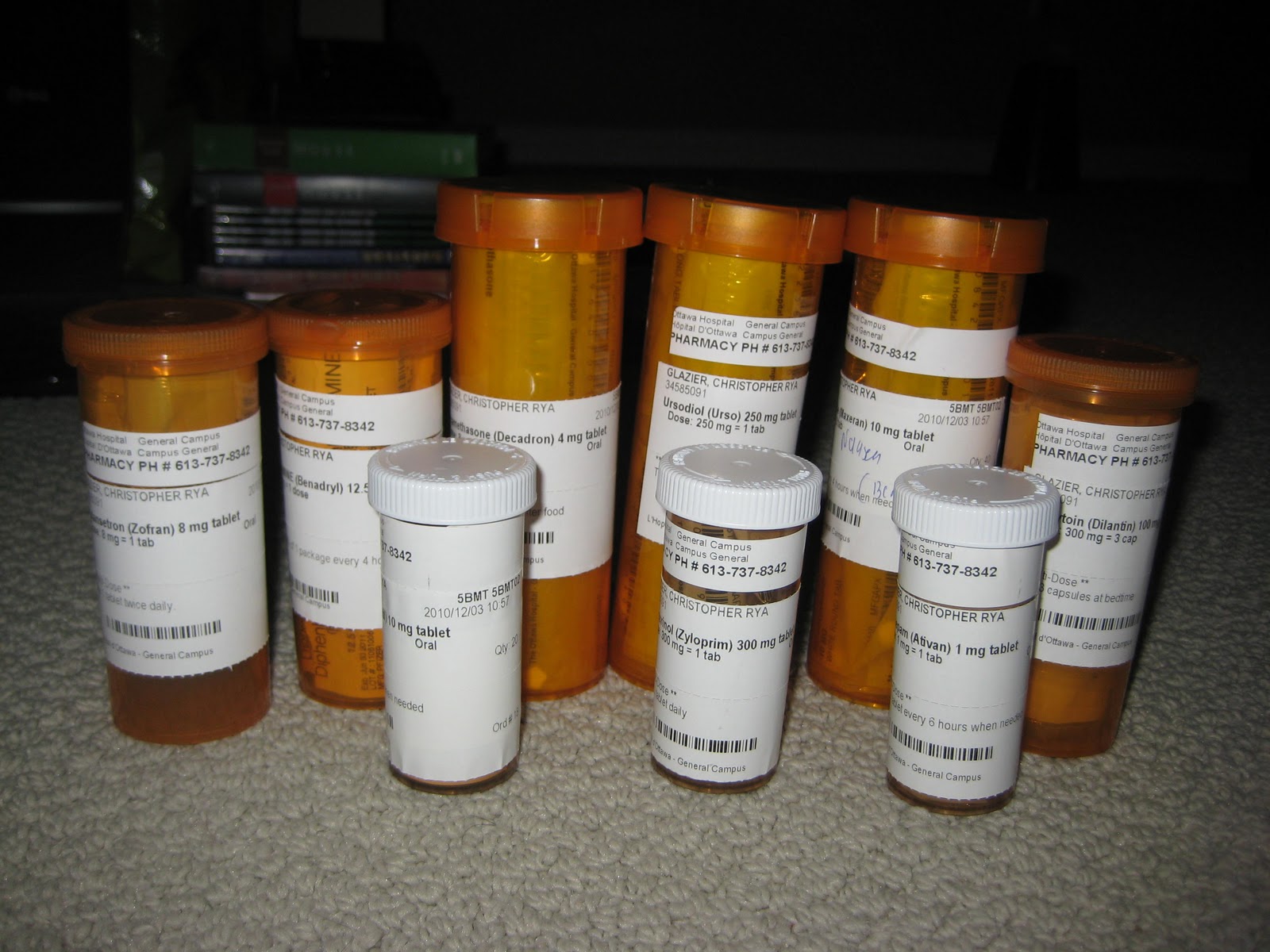
We also received Chris' medication chart for the next little while.
Dilantin to prevent seizures (three pills three times a day for the first day and then once a day after that for five days).
Ursodiol to protect the liver (one pill four times day).
Allopurinol to protect the kidneys (one pill once a day for nine days).
Zofran to prevent nausea (one pill twice a day for 10 days).
Decadron to prevent nausea (two pills twice a day to prevent nausea).

Chris was also given a bunch of other medications to use on an as needed basis.
Prochlorperazine for additional nausea (one pill every four hours as needed).
Maxeran and Benadryl for additional nausea (two pills and one half pill of Benadryl every 4 hours as needed).
Ativan for sleeping problems and anxiety (one pill every six hours as needed).

So far, we are much bigger fans of Busulphan than the Cyclophosphamide. Other than feeling a little dizzy, Chris is doing well. He can continue to drink coffee and we don't need to wake up every hour on the hour (Busulphan 3, Cyclophosphamide 0).

Thursday, December 2, 2010

Day -11


Where do we begin?

Well, first I will start with the title of this blog post. We received Chris' schedule today and that is what they refer to today as. Since Chris will be receiving his stem cells on December 13, they refer to it as Day 0. Everything that happens before that is just a countdown to that date, so today is T minus 11 days until the transplant. Make sense?

So here is what Chris' schedule looks likes, and it is more or less what we expected.

December 2 - Planning appointment, and PICC insertion.

Yes, Chris was surprised this morning when we got a call saying that he was getting his peripherally inserted central catheter (PICC) line in today. This is the cathether that they insert in his arm and feed up through his vein into his shoulder and down near his heart. Chris was not looking forward to this at all, but they froze the area, it only took an hour and he didn't feel anything! The benefit of the PICC is that it limits the amount of times Chris needs to get needles. The downside is that he can't get it wet, so he will need to shower with a bag around his arm.

Chris also starts his anti-seizure medication tonight as the chemotheraphy that he begins tomorrow may cause seizures. I am very happy about this, because I have had a fear of seizures every since I was trained as a lifeguard at 16. Of all the things to worry about, I know it shouldn't be that high on my priority list, but seizures just look really scary.

December 3 - Chris is admitted to the hospital (this is so he doesn't need to go through emergency and he can choose to stay at the hospital if he doesn't feel up to going home). He also meets with the pharmacist where we learn all about the drug regimen he will be on. And of course, Chris will start his first chemo drug, Busulphan, for four hours. He also takes medications to prevent gout and damage to his liver.

December 4 - Chris has 2 hours of Busulphan

December 5 - Chris has 2 hours of Busulphan

December 6 - Chris has 2 hours of Busulphan

December 7 - Chris gets a rest day from chemo and stops taking his anti-seizure medication. We have to start monitoring Chris fluid intake and output to make sure that chemo is quickly getting out of his system, because the next day we start Chris' favourite drug, Cyclophosphamide (sorry, for the sarcasm).

December 8- Chris start Cyclophosphamide for the next four days. This was the chemo that Chris took in November that requires you to drink every hour and go to the washroom every hour. This was the chemo that required us to go to the hospital at midnight, because Chris decided to retain all of the liquid (yes, I am blaming him for this!) Since getting up every hour for four days straight is extremely exhausting, we will have the option to admit Chris and have him hooked up to hydration and catheterized. He is still deciding on that one.

December 9 - Chris will have Cyclophosphamide and an infusion of Antithymocyte Globulin (ATG). While the chemo drugs will wipe out his white blood cells, this medication will wipe out his T cells (the cells that are behind multiple sclerosis). Since ATG is derived from the serum of rabits and horses (weird, I know) the body reacts against it and you have an allergic reaction. Due to this, they will be giving Chris a bunch of allergy medications to prevent this. The ATG is also given slowly over a long period of time to limit the reaction.

December 10 - Chris will have Cylclophosphamide and ATG.

December 11 - Chris will have Cylclophosphamide and ATG

December 12 - Chris will have ATG and hydration.

December 13 - Chris will get his purified stem cells back! Apparently they are kept in dry ice and it looks really cool when then bring them out to defrost them. I promise to get photos of that!

They told us that following all of this, that the hard part will then begin. Approximately 10 to 14 days after this Chris will hit zero white blood cells and have no immune system. It will then take another two weeks until he starts to stabilize. During this time he will get antibiotics to treat infections, Intravenous immunoglobulin (IVIG), which I am pretty sure is a blood transfusion, and our good friend Neupogen to boost his stem cell production. Neupogen was the other drug that hospitalized Chris last time due to the extreme pain he was in. Although we have been assured that it will not be painful this time.

Chris will continue to have the IVIG once a month for a year and will need to keep his PICC line in for about 6 weeks.

So we promised you a nice long post, and I think we delivered. We also threw in the last picture for fun! We figured this blog entry was far too serious.

Oh and a quick thank you for the Christmas trees, decorations and treats we received. We are decorating our house tonight and we will show it off in future posts!

Wednesday, November 17, 2010

Day 35

So we finally have received a date from the Bone Marrow Transplant team.

Chris will begin the second half of this procedure on Thursday, December 2. We will be going in for our planning meeting (similar to the one we did on Day 1) where we will get our full list of appointments, as well as a detailed chart of all the drugs Chris will be on.

Next, on Decemeber 3, Chris will be admitted to the hospital and have his PICC line inserted and start chemo again. While Chris will technically be doing out-patient treatment, they will admit Chris as he will be at the hospital everyday and will very likely need to be admitted overnight throughout.

While the full schedule still needs to be approved by Dr. Atkins, we were told that the stem cell transplantation is tentatively scheduled for Monday, Decemeber 13. This is often referred to a "Day 0". After this day you start recovering and building a new immune system. Some people even consider it their new birthday. Chris will likely try and pull off having two birthdays now.

I didn't realize how incredibly nervous I was about this until we found out the date. I am finding the need to make lists of things we will need. What to pack in our hospital bag? What to buy for groceries that Chris will be able to eat? Having a Type-A personality can really drive you insane during something like this.

On a much brighter note, Chris and I will be celebrating our two month wedding anniversary tomorrow! Yes, I know, it is pretty huge milestone. But I figured since we missed our one month anniversary (if you look back you will see we celebrated by getting to do Chris first neupogen injection! It was very romantic) and our three month anniversary is sort of out the window, that two months is as good a reason as any to celebrate.
So tomorrow I have assured myself that Chris will:
a) remember, and
b) come up with some romantic gesture, an elaborate surprise, that will surely knock me off of my feet and remind me why I married him.

He, of course, did NOT just realize these facts after finishing reading this blog post and is NOT now sweating profusely.

I'm kidding. Happy Anniversary, Chris! I hope our next month of marriage is full of little surprises and lots of luck!

Wednesday, November 3, 2010

Day 21 - A Setback

So today we ended up going into the hospital where we received both good news and bad news. To start, we ended up going into the hospital because last night it appeared that the rash that Chris was having had spread to the rest of his body. He had marks all over his stomach, chest, back and head. When we called the hospital to let them know, they were a little concerned and asked us to come in so that Dr. Atkins could take a look at Chris.

So here is the good news:
- The rash was nothing serious. It turns out all the marks all over his body are seperate to the ones on his arm. The ones on his arm are likely an allergic reaction to the tape that they used when he had his stem cell collection. The marks on his body are due to Folliculitis (an infection of the follicles). It is nothing serious and they will likely clear up on their own. It apparently is really common in immunocompromised patients. Chris needs to continue using the hydrocortisone and it should clear up.

Here is the even better news:
- When Dr. Atkins walked in the first thing he said to Chris was, "Wow, you still have all your hair! Are you sure you even had chemo?" That definetly felt great to hear. Everyone seemed surprise with how well Chris is doing. Chris also was cleared to have visitors as long as they aren't sick, to go out to restaurants (as long as it not fast food or any of the high risk foods), and to leave the house (as long as we aren't going to really busy areas, i.e. the mall on weekends, the movies or sporting events).

Now here is the bad (and frustrating) news:
- We found out today that since the bone marrow transplant (BMT) team received an ususally high number of leukemia patients this Fall, that Chris is now being bumped until the beginning of December. They can only have a limited number of patients go through the BMT at the same time, and since leukemia patients are much more time sensitive and in a far more serious condition, they get to go first. It is completely understandable and extremely frustrating at the same time. We were hoping after we heard how great Chris was doing that we could start as early as next Thursday and now we have another month of waiting and thinkng and more waiting.

We also now need to change our plans. Originally I was planning on taking off work until the end of December, work from home in January and then return in February. Now that Chris won't be starting until December he will still be needing me to be off work until the end of January. Since I am already maxed out on sick leave, I will need to look at working from home right now. Chris' doctor does not think that Chris should be going back to work. Even though he feels fine, he is still susceptible to infection and if he overexerts himself or comes into contact with people who are sick, it could delay his BMT even longer. The longer we wait, the more likely Chis will have a relapse since he is not on any MS medications.

Finally, we did get some updates from Dr. Atkins on the procedure. Since we had been seeing a bunch of different doctors, we had been getting a lot of different answers when asked about the specifics of Chris' procedure. Since Dr. Atkins is the expert on the treatment for MS patients, he was able to clarifiy some things for us. Instead of having a Hickman catheter, Chris will have a peripherally inserted central catheter  (PICC), which will be inserted in a vein in his arm and fed up his vein into his chest (kind of gross!) He will be able to keep it in for six months, and he will need to keep it dry.

We also learned about the chemo regimen Chris will be on. He will start with four days of busulfan, one day of rest, then four days of cyclophosphamide, then another day of rest, and then two days of antithymocyte globulin.

So now that we have a better grasp on what we can expect, he unfortunately will not be getting it until December.

Monday, November 1, 2010

Day 19 - CCSVI

Almost exactly a year ago at this time, we started getting emails and comments from friends and family about  a new breakthrough in MS called Chronic cerebro-spinal venous insufficiency (CCSVI). In November 2009, it was reported that an Italian doctor, Paolo Zamboni claimed that MS was not an autoimmune disease and that it was due to malformed or blocked veins in the neck that couldn't adequately drain blood from the brain. Zamboni claimed a buildup of iron in the brain ensues from this blockage, causing vertigo, fatigue, vision problems and loss of sensation. He also announced a new "liberation" procedure that involved using a form of angioplasty — injecting and inflating balloon catheters into dilated veins to increase blood flow.

Since we announced that we were doing the stem cell treatment, a lot of people have asked us if we had considered doing this liberation treatment instead.

To be honest, before we even knew about the stem cell treatment, we tried desperately to get Chris' neck scanned to see if he had CCSVI. Unfortunately, in Canada and the United States this scan is not covered as it is considered experimental. Last May, after trying for months, we eventually were able to get Chris on a waiting list to have his neck scanned (if it was confirmed that he did have it, we would need to pay upwards of $20,000 to have the liberation procedure performed in another country such as Costa Rica, Germany, India and Kuwait), but to this day we have yet to hear anything. There are trials now going on in Canada and the United States, but since there are approximately 75,000 Canadians with MS, the spaces filled immediately.

Now, after learning a lot about both treatments, there is not a questions in our minds that we made the right decision. Since the announcement of this treatment, several different trials have come out with mixed results.
A large ongoing study in Buffalo only showed that 62% of MS patients had CCSVI, but so did 26% of the healthy participants, as well as 45% of participants with other neurological disorders. A medical centre in Amsterdam has found no difference between the veins of MS patients and healthy participants. Also, while many patients diagnosed with CCSVI have undergone the treatment have reported great results, there are patients who have undergone the procedure and have not felt any improvements. This procedure is also relatively new, and there are no research on the longterm effects. We definetly understand why so many people are spending money to get it done. When we had no other options we were definetly planning on doing it. It just wasn't the right choice for us.

In other news, Chris is still doing well. We are expecting a call from the nurse coordinator tomorrow to see if there is anything else Chris can take to bring down his hives on his arms (yes, they are still there!).

And on a much lighter note, here are some photos of our Halloween costume last night. We were bikers and obviously really tough ones.

Sunday, October 24, 2010

Day 11

After all of the excitement of the weekend, we have been trying to be as uneventful as possible. Good for Chris' health, bad for writing a blog.

Chris is still on the painkillers, and every so often believes he is tough enough that he doesn't need to take them anymore and about 15 minutes later changes his mind.

The drugs aren't making him feel the greatest, and he doesn't have much of an appetite. But he did insist on going to the grocery store( i.e. sent me out to the grocery store) so that he could have some chocolate chip cookies in his ice cream. I am not that concerned about his lack of appetite anymore.

We are starting to get excited for the end of the week when Chris will be off of his medication, will have finished his stem cell collection, and will be getting better by the day (instead of getting worse).

For your viewing pleasure we have a link to a W5 piece on the bone marrow stem cell transplant.
http://www.ctv.ca/CTVNews/WFive/20090213/w-five_ms_090213/
Just a few thing to keep in mind when you watch it:
1) Since the death of the MS patient in the clinical trial, there have been changes made to the procedure to make it more safe.
2) The best results have been seen in relapse remitting patients, such as Jennifer Molson (featured in the piece) and Chris
3) The stem cell treatment in China is nothing like the one that Chris is doing
4) W5 is a just a little dramatic sometimes.

Thursday, October 21, 2010

Day 8 - How did we get here?

I am starting to get concerned that this blog is turning more into updates about Chris' hair than his transplant. Chris decided to change his hair for the third time today and had me buzz it all off. And yes, we have included yet another photo of Chris' hair. We promise to try and take more interesting photos in the future.

Since today is just another rest day, we thought we would take this opportunity to go back a little bit and explain why Chris made the decision to do this procedure. We have recieved a lot of support from friends and family, but one of the common questions is, "Isn't there anything else you could have tried instead?"

In short, not really.

Chris was first diagnosed with  relapse remitting multiple sclerosis in February 2007. There are four kinds of MS: relapse-remitting, primary-progressive, secondary-progressive and progressive-relapsing. Relapse-remitting means that you have a series of relapses when symptoms get worse and remission when symptoms improve. At the time of diagnosis, most people have relapse-remitting. However, more than half will eventually develop secondary-progressive. Secondary progressive is when you have relapses, but you stop having periods of remission and experience a slow but steady worsening of symptoms.

As early as January 2005, Chris had gone to the doctor on multiple occassions due to weakness and numbness in his arm and legs. Finally he was evaluated by a neurologist in December 2006 when the entire left side of his body went numb, including his face that appeared to be drooping on the one side. She sent him to get an MRI and it came back with multiple lesions on his brain, the main indicator for multiple sclerosis. Chris started taking a drug called Rebif that required injections 3 times a week. The drug is not a cure, but it reduces the number of relapses and  slows down the progression of the disease. When Chris had a relapses they would prescibe him high-dose steroids. The combinations of the Rebif and steroids seemed to be very effective at first.

 From April 2007 to September 2009, Chris had approximately 3 relapses affecting primarily his left side of his body in his leg, arm and face. We also noticed a slight decline in his balance and memory. However, in September 2009, while Chris was working for three weeks in Nunavut, he had a relapse that affected his vision and balance. In February 2010, he had a major relapse that affected his leg and made it difficult for him to walk even short distances. When he took steroids, it took over 2 weeks for him to walk normally again. Prior to this, Chris would notice a major improvement within 48 hours. A month later, Chris had another relapse that affected his left leg. It was so bad at some points that he needed help getting from the car to the front door. This time it took almost a month before Chris started to feel any big improvements.

We also noticed over the winter that Chris was never getting back to 100 per cent. Even after a relapse, Chris could no longer run or skate and his memory and balance were continuing to get worse. When we met with his neurologist, she confirmed what we feared. Chris was nolonger responding to his medication and he had started to develop Secondary-Progressive MS. We were told that unless we took action, Chris may lose his ability to walk without an aid.

We had two options:
- A new drug called Tysabri. It had shown to be really effective at reducing relapses in MS patients, but you risked contracting a brain infection called PML (for which there is no cure and results in death). The risk for this infection increases the longer you are on it, so Chris would only be able to take if for 2 years.
- The Stem cell transplant, which also had a risk of death and serious complications.

It wasn't exactly an easy decision. We were referred by Chris' current doctor, to a hematologist, who explained the entire procedure for us. We did a TON of research. We searched the Internet and journal articles for everything there was written. We even read patients' blogs (one of the main reason why we are writing this blog) to understand why they decided to pick a certain treatment. I even went so far as to make a chart with the pros and cons of all the options we could find. In the end, the stem cell transplant, despite it being the most dangerous, was the only option that gave us an end. If this could really stop the progression as it had in other patients, then it would mean an end to medicatons, an end to the relapses and an end to the worrying.

Since the stem cell transplant is still an experimental treatment, Chris still needed to be accepted. Luckily in June after we met with another neurologist that specialized in treating MS patients, he determined that Chris was an ideal candidate.

So this brings us to now. We are meeting with a bunch of Chris' doctors again tomorrow to see how he is progressing. And of course, we will let you all know.

Wednesday, October 20, 2010

Day 7

It has now been a week since we started this whole process, but it really seems like it has been a lot longer (time doesn't fly when you aren't allowed to do much).
We don't have too many updates today:
- Chris is finally off his anti-nausea medication so his hiccups are finally gone (some people have said that hiccups at least weren't too bad of a side effect, but you should have seen how crazy Chris was after a two hour hiccups attack)
- Chris is starting to get joint pain in his knees and hips from the neupogen

Since we don't have a lot to update you on, we thought we would post a link to an article on one of the patients that had this procedure done as part of the clinical trial.

Her name is Jennifer Molson and Chris and I have had the opportunity to meet and talk to her multiple times to find out what this process is really like. Her results were incredible. At the time when she participated in the trial, patients needed to be much further along in their MS to be considered for the trial. When she started, she was unable to walk, but today she can run, dance and has even been downhill skiing. You can read about it more here:
http://stemcellfoundation.ca/blog/2010/05/06/i-still-have-ms-but-i-dont/

Tuesday, October 19, 2010

Day 6 - Waiting

Chris is still doing really well and other than taking his injections and medications, we are leading a very uneventful life (not that I am complaining!)

We thought that we would take this opportunity to explain this procedure to everyone (since many of you only know the bits and pieces we have explained).

For those of you who don't really know what stem cells are (I didn't really know until we started this), they are made in the bone marrow are known as "mother" cells as they are capable of making another cell identical to themselves and to make other cells, which eventually become red cells, white cells, or platelets.

Chris is having an autologous stem cell transplantation. This means that doctors are planning to collect Chris' own stem cells, fix them, wipe out Chris' immune system and then transplant them back to Chris so that he can grow a new immune system that will no longer attack his neurological system. For this to work, Chris will need to undergo high dose chemotheraphy to ensure that he absolutely no immune system left.

Here is a rundown of how it will work:

There are two phases to this procedure: the collection phase and the transplant phase. We are currently in the collection phase, which consists of one dose of cyclophosphamide (chemo) and G-CSF (neupogen) to lower his white blood cell count and boost his stem cell count. This will cause him to make so many stem cells that they will actually overflow from his bone marrow and into his blood stream. After doing this for 10 days, Chris will have a stem cell collection. During the collection, a needle will be inserted in each of Chris' arms and blood is withdrawn from one arm and circulated through a cell seperation machine to extract the stem cells. The remaining parts of the blood are returned back to Chris through the needle in the other arm. The process can take up to 2 days, with 6 to 8 hours of collection each day. However, the doctors have indicated that we may be able to just do one day of collection.

Next Chris will rest for 2-3 week, so that he can be ready for the second phase. During this time, doctors will treat Chris' stem cells, so that they no longer have the specific cell (the T-cell) that triggers the attack on the immune system. He will regrow new ones that will (if everything works) function normally.
Prior to the second phase, Chris will also have a surgery to have a central venous catheter (known as the Hickman catheter) inserted into a large vein in his chest. This will be used to give blood and drugs throughout the next phase and during his recovery.

The second phase, which will likely start sometime between the middle of Novemeber to the beginning of December. To get rid of his current immune system that is causing MS, Chris will recieve three drugs through the Hickman catheter or IV: Busulphan (chemo) in high doses, more cyclophosphamide (chemo) in high doses and antitthymocyte globulin (an immune suppressant). Following this, Chris will recieve his improved stem cells. It will then take Chris about 6 months to regrow the majority of his immune system. During this time, his ability to fight infections will be extremely low.

So there it is in a nutshell. Hopefully, this clears up questions about how the procedure works. In the clinical trial that finished last February, this procedure was successful in stopping the progression of MS in all patients, and some patients even saw an improvement in their symptoms. The trial started back in 2002, and we have had the opportunity to meet one of the patients who went through the procedure and has seen great results. She went from not being able to walk without assistance to downhill skiing!